
Why can two types of steel with a similar chemical composition behave completely differently in practice? The answer lies not only in what the material contains, but also in how its atoms are arranged.
Table of Contents
- Allotropy of Iron: The Foundation of Steel Structure and Properties
- Allotropic Forms of Iron
- Ferrite and Austenite: How Crystal Phases Affect Steel Properties
- Allotropy of Iron in Steel Heat Treatment
- The Role of Alloying Elements in Phase Stabilization
- Why the Allotropy of Iron Is Critical for Industrial Customers
From an industrial perspective, understanding the role of phases such as ferrite and austenite is not merely theoretical; it is a practical tool for optimizing production processes, improving product quality, and selecting the right material for a specific application.
Allotropy of Iron: The Foundation of Steel Structure and Properties
Steel owes its versatility not only to its chemical composition, but above all to iron’s ability to change its crystal structure with temperature. This phenomenon, known as allotropy, forms the foundation of all mechanical and technological properties of steel.
You can read more about the chemical composition of steel in our article: What Is Steel? Composition and Definition of Steel.
In practice, this means that iron atoms can arrange themselves into different crystal lattices depending on thermal conditions. Each of these structures exhibits distinct properties, such as hardness, ductility, strength, and carbon solubility. These differences determine how steel behaves both during production and in service.
From an industrial perspective, this mechanism makes it possible to engineer steel with precisely defined properties, from high strength to enhanced wear or crack resistance. Without the allotropy of iron, steel would not be such a widely used material in modern engineering.
Allotropic Forms of Iron
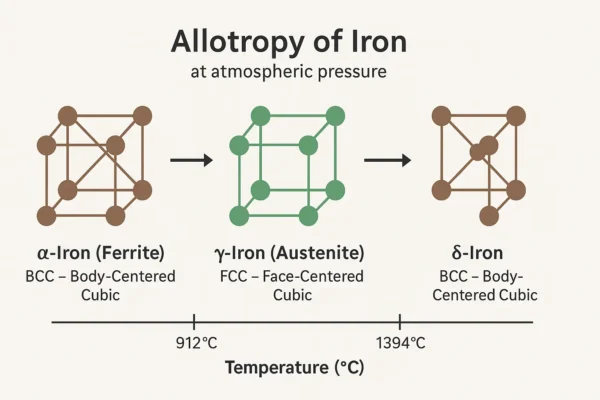
As temperature changes, iron atoms reorganize into different crystal arrangements, forming what are known as allotropic forms.
In industrial practice, three main allotropic forms of iron occur at atmospheric pressure:
α Iron (Ferrite)
Ferrite exists at lower temperatures, from room temperature up to approximately 912°C. It is soft, ductile, and magnetic until it reaches the Curie point (770°C). In practice, it forms the basis of low-carbon steel and strongly influences machinability and weldability.
γ Iron (Austenite)
Austenite appears at higher temperatures, from 912°C to 1394°C. In this form, iron is non-magnetic, ductile, and capable of dissolving significantly more carbon, which is essential for steel heat treatment. Thanks to austenite, hardness and strength can be controlled through quenching or through the formation of other microstructures.
δ Iron
δ iron exists only just before melting, between 1394°C and 1538°C. Although its role in everyday steel production is limited, it is important in casting and solidification processes, where it contributes to uniform solidification and reduces ingot defects.
Ferrite and Austenite: How Crystal Phases Affect Steel Properties
The allotropic forms of iron directly influence both manufacturing processes and the final properties of steel.
Ferrite – Softness and Ease of Processing
Ferrite is responsible for the ease of forming and welding steel. Thanks to its softness and ductility, it enables the production of components with complex shapes without the risk of cracking.
Practical effects of ferrite:
- steel is easy to bend and stamp,
- good weldability with minimal risk of thermal distortion,
- low hardness allows the production of components requiring stress tolerance.
Austenite – High-Temperature Ductility and Preparation for Hardening
Austenite allows steel to absorb more carbon, which underpins hardening processes and the formation of hard microstructures such as martensite and bainite.
In practice, this means steel can be strengthened and hardened in a controlled way while maintaining adequate toughness and impact resistance.
Practical significance of austenite:
- enables higher hardness after heat treatment,
- improves impact and wear resistance,
- a critical phase in tool steel and structural steel requiring durability, such as cold-work tool steel and hot-work tool steel.
Allotropy of Iron in Steel Heat Treatment
In industrial practice, controlling temperature and cooling or melting rates allows manufacturers to transform the microstructure of steel, creating desired phases and mechanical properties.
- Quenching involves heating steel to the temperature range where austenite dominates, followed by rapid cooling. During this process, carbon becomes “trapped” within a hard structure known as martensite. The result is a significant increase in hardness and strength, making steel ideal for applications where the material must withstand heavy loads or abrasion. This process is commonly used in the production of steel for heat treatment, case-hardening steel, and wear-resistant steel.
After quenching, steel becomes very hard but also brittle, which is why additional heat treatment is often required.
- Tempering reduces internal stresses and improves impact resistance. This allows components to maintain the right balance between hardness and ductility, which is essential in mechanical engineering and structural applications.
- Annealing and Normalizing involve controlled heating and cooling to achieve a uniform microstructure and optimal grain size. The result is improved ductility and greater material homogeneity.
The Role of Alloying Elements in Phase Stabilization
Alloying elements such as chromium, nickel, manganese, and molybdenum allow manufacturers to modify steel properties and stabilize specific crystal phases. This enables the production of steel with precisely tailored mechanical and corrosion-resistant properties.
Nickel (Ni): stabilizes austenite, increases toughness, and improves crack resistance at low temperatures, making steel more reliable in structural and cryogenic applications. Commonly found in stainless steel.
Chromium (Cr): stabilizes ferrite and improves corrosion resistance. It is essential in heat-resistant ferritic steel and wear-resistant steel.
Manganese (Mn): improves hardenability and strength while increasing crack resistance, which is particularly important in structural steel.
Molybdenum (Mo): improves high-temperature strength and wear resistance. Frequently used in spring steel.
You can read more about alloy steel in our article: Types of Steel and Their Applications.
Why the Allotropy of Iron Is Critical for Industrial Customers
Understanding and controlling the transformations between ferrite, austenite, and δ iron is the foundation of modern metallurgy. These transformations allow manufacturers to precisely engineer steel microstructure, and therefore its mechanical properties and in-service performance.
Key Benefits for Industrial Customers
- Precise microstructure control: allows steel to be produced with the desired proportions of ferrite, austenite, martensite, or bainite.
- Tailored mechanical properties: from hardness and impact toughness to ductility and crack resistance.
- Production process optimization: heat treatment, quenching, tempering, welding, and casting become more predictable and repeatable.
- Application-specific steel selection: for example, structural components exposed to dynamic loads, precision components, or high-durability tools.
- Predictable material behavior: final properties can be estimated without costly trial-and-error testing.
- Control of carbon solubility and alloying reactions: allotropic transformations determine how carbon and alloying elements (Cr, Ni, Mn, Mo) influence steel hardness, ductility, and resistance.
In practice, this means that the allotropic forms of iron are not just a theoretical concept. They are a practical tool that directly affects the quality, durability, and reliability of steel products.